Hello_World
A monthly risk index, built as a successor to the Doomsday Clock.
Draft. Not reviewed. Please don't cite.
The reading below was drafted from public sources and has not yet been confirmed by me or checked by outside reviewers. The method is a first draft (v0.1), and about 65% of the headline still rests on estimates rather than measured data. It is shown here so you can see what the project looks like, not as a finding.
Latest reading: November 2026, 63.5 out of 100
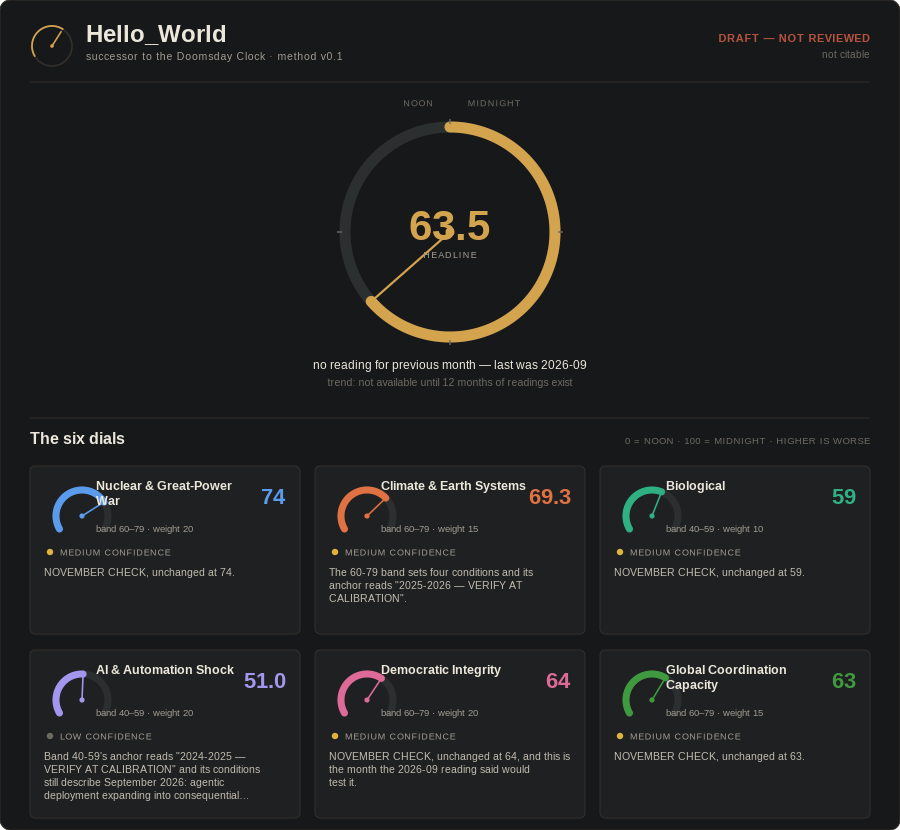
| Area | Weight | Score | Band |
|---|---|---|---|
| Nuclear & great-power war | 20 | 74 | 60–79 |
| Climate & Earth systems | 15 | 69.3 | 60–79 |
| Biological | 10 | 59 | 40–59 |
| AI & automation shock | 20 | 51.0 | 40–59 (low confidence) |
| Democratic integrity | 20 | 64 | 60–79 |
| Global coordination capacity | 15 | 63 | 60–79 |
The previous reading was September 2026, at 62.7. There was no October reading. November updated the two areas that move with data (climate and AI) and carried the other four forward after checking each against its list of events that would force a change.
What it is
The Doomsday Clock moves once a year, doesn't publish how it is scored, has only ever moved toward midnight, and was designed around nuclear war. Hello_World keeps the clock face but changes three things:
- Midnight means something different. Not extinction, but the loss of the capacity to correct course. That lets slow, partly reversible failures, such as runaway warming or an election that no longer changes who governs, sit on the same scale as sudden ones.
- The rules are written down. Six areas are each scored 0–100 against a written rulebook and combined into one headline. The aim is that a hostile critic, given the same rules and the same data, gets the same number.
- It is monthly and committed in advance. Readings come every month, the events that force an immediate re-reading are listed ahead of time, and every change is recorded with its reason.
The headline isn't a plain average. If one area is in serious trouble it pulls the headline up with it, because a single catastrophe isn't diluted by five quiet areas. That rule only applies when the score behind it is held with at least medium confidence; when a low-confidence score would have driven the headline, the reading says so.
Where it stands
| Stage | State |
|---|---|
| Frame: name, what midnight means, the six areas, weights | done |
| Method: scoring rules, tested against nine historical dates | first draft done |
| Data: collect, score, rebuild 2015 to now | in progress: 27 of 29 data feeds working, ten years of monthly history, most of the headline still estimated |
| Face: the clock image | first version done |
| Outside review | started November 2026, no reviewers yet |
| Launch | not started |
The project's working files are private for now, while the method is still a draft. If you'd like to be a reviewer, get in touch.